Model Context Protocol (MCP) servers are lightweight programs that act as a bridge between LLMs (like Claude, Gemini, Cursor) and external tools/data sources, enabling AI to access local files, databases, APIs, and web search in a standardized way. They act as a, "toolbox" to extend AI capabilities, such as fetching documentation, managing cloud resources, or performing web searches.
MCP is an open-source standard introduced by Anthropic in 2024 to create a standardized way for AI models (Large Language Models) to communicate with external data sources, applications, and tools.
The MCP Server is a program that provides AI applications, such as large language models (LLMs) and AI agents, with a standardized way to access external data, tools, and services. It acts as a crucial bridge, enabling AI to go beyond its training data, access real-time information, and perform specific actions in the real world.
MCP Client → MCP Server
Client asks, server executes.Think of it like API server vs API consumer, but designed specifically for LLMs and AI agents.
You make tools on MCP servers and MCP client used it via LLM.
- LLM decides which tool to use
- MCP client performs the call
- MCP server executes the logic
LLM <-----> MCP Protocol <-----> Tools / APIs / Databases
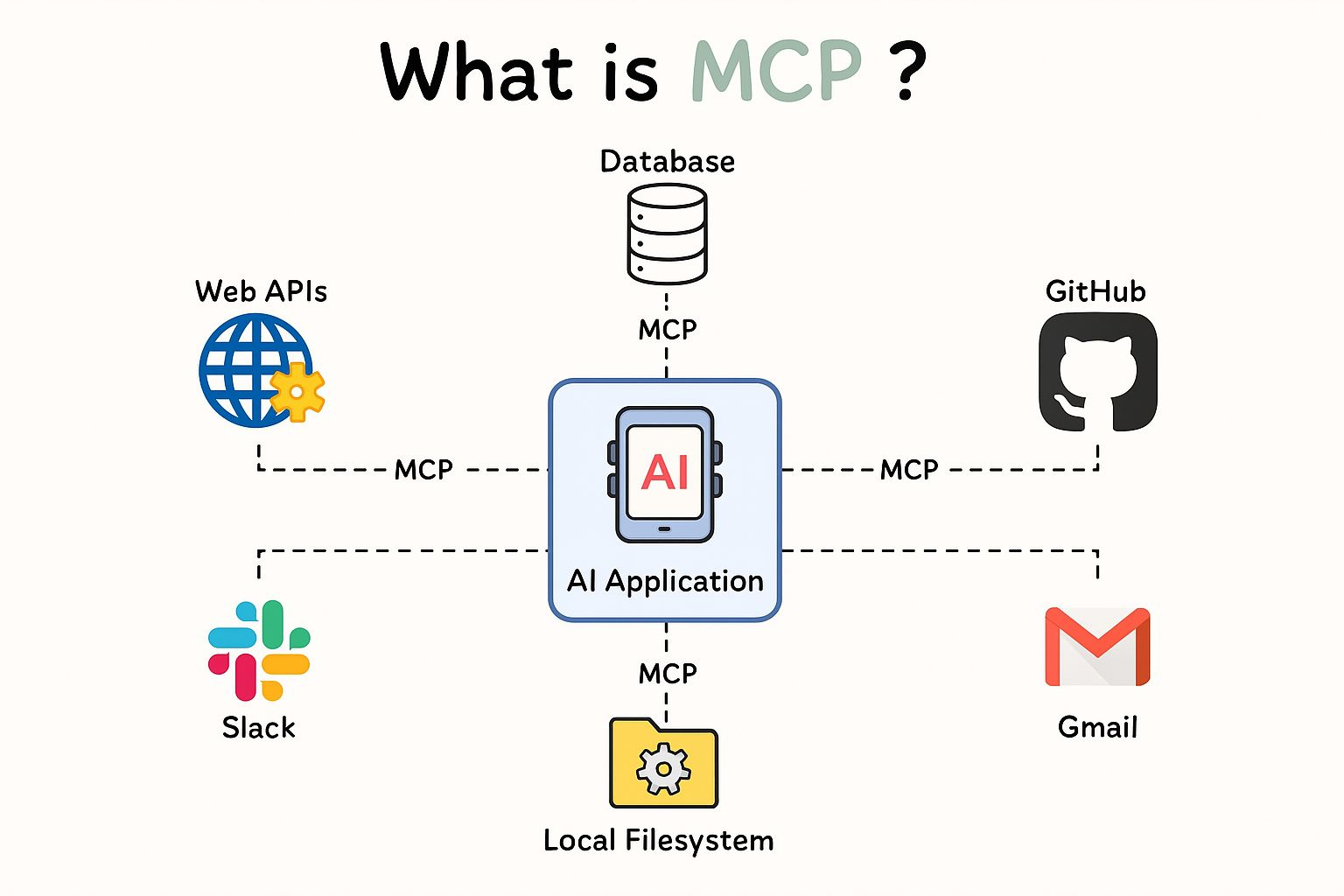
An MCP Server is the actual program that exposes tools using MCP.
LLM --> write an essay, but i can't send email
LLM--> write a query, but can't run the query
We can make MCP server of mango db, figma if they have api expose to public.
Model : is AI model, context is important for any LLM, if i am getting error is mentioned in any issue or being discussed in slack or look at stackoverflow or anywhere etc.
To achieve above,
Need access to slack, are small tools or software.
Context Type : Context has following
1. Tools: function
2.Resources like attachement(csv file)
3.Sampling : way to query other model, like we write code from claude but testing from gemini, but readme file is by open ai.
4. Promopts: templates for clients
Protocol :
- Standardized Connection: It acts as a universal "connector" or "wire," similar to a USB-C port, allowing different AI applications to securely connect to diverse data sources (local files, databases, APIs) without requiring custom integrations for each, as shown in.
- Bridge to Context: The protocol enables AI to gain real-time "context"—information outside its training data—needed to perform tasks more accurately and take actions.
- Client-Server Architecture: MCP defines a structured way for a "client" (e.g., an AI-powered IDE like Cursor or Claude Desktop) to connect to a "server" (the application holding the data).
Key Components: The protocol specifies how to manage different types of contextual data, which are often referred to as "primitives":
- Resources: File contents, database records, etc..
- Tools: Functions that the AI can execute.
- Prompts: Pre-defined templates for interaction.
- Security: The protocol includes built-in security features, such as OAuth, to ensure secure communication between the AI and the external tools.
Pulsemcp website:
https://www.pulsemcp.com/servers/rectalogic-langchain
A daily-updated directory of all Model Context Protocol (MCP) servers available on the internet. Connect your AI apps to external data sources and services.